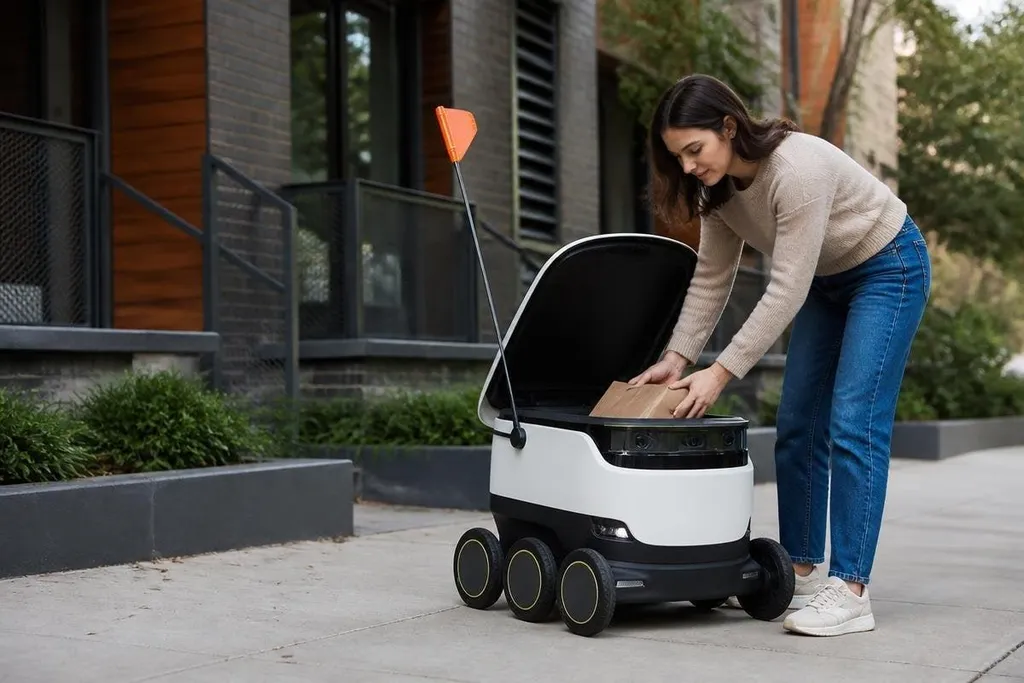
A delivery robot earns money only when it completes a repeatable route at a cost the customer accepts. The business opportunity sits around that route: robot leasing, fleet software, charging, remote support, and site services.
Quick read
- Fleet service contracts can spread the robot’s cost over many deliveries.
- Short, repeatable routes are easier to price than open-ended city work.
- Human handoffs, charging, permits, and failed deliveries can decide the margin.
The robot is only one sale
A company buying delivery robots may not want to own every part of the system. It may prefer a service that includes the robot, software, maintenance, remote support, and a replacement unit when one stops working.
That creates room for a robotics-as-a-service model. The customer pays for completed routes, operating hours, or a monthly fleet plan instead of paying the full equipment cost at the start. The supplier then carries more financial risk, so it must keep each robot working and each route busy.
The same model can work for campuses, hospitals, hotels, warehouses, and residential sites.
A robot moving meals across a hospital needs different safety checks from one carrying parcels across a private campus, but the buyer still cares about uptime, staffing, and cost per delivery.
Revenue close to daily work
The clearest business lines sit close to daily operations. Fleet leasing lets a supplier own the robots and charge for their use, while route software assigns jobs, tracks robots, and sends status data to staff.
Remote supervision adds another service. A person helps when a robot meets an obstacle, loses a signal, or reaches a blocked path. Site preparation covers route mapping, charging points, and changes to doors or lifts. Maintenance work includes checks on wheels, batteries, sensors, seals, and cargo doors.
The software may also connect with ordering, dispatch, or building systems. That connection matters because a delivery robot still needs a clear job, a pickup point, and a person who can receive the package.
The route turns a delivery robot into a business cost: distance, stops, charging, and staff handoffs affect each run. Managers comparing suppliers can use Robot 24 to compare those details across named machines and reported deployments before pricing the route.
The route decides the economics
A short route with fixed pickup and drop-off points gives an operator more control. The company can measure travel time, charging needs, staff handoffs, failed deliveries, and the number of jobs a robot completes in a shift.
Open public routes are harder to price. Weather, road crossings, construction, crowds, theft, and local rules can change the work from one day to the next. Those conditions may also require more remote staff, which raises the cost of each delivery.
The handoff deserves attention. A robot may reach the destination, but a worker still has to load the cargo, open the compartment, confirm the recipient, or deal with a missed delivery. If that work stays manual, the robot may reduce travel work without reducing much labor.
Charging creates another limit. A fleet needs a place to charge, a plan for busy periods, and enough spare capacity when batteries take a robot out of service. The sales price means little until an operator knows how many completed deliveries each robot can support.
What buyers should check
A buyer can test the business case with a small route before signing up for a large fleet. Ask for records from the exact type of site under review, not a route with easier conditions.
- Count completed jobs: Set the number of deliveries needed per shift and record failed handoffs.
- Price human support: Include remote operators, site staff, dispatch work, and service visits.
- Check the route: Map doors, lifts, crossings, ramps, charging points, and areas where people gather.
- Set service terms: Define repair times, spare units, battery replacement, software support, and safety reporting.
- Test the exit plan: Decide who removes the robots and data if the route stops making money.
I'd start with one fixed site and a short service contract. That gives the buyer real operating data before a larger equipment purchase locks in the wrong route.
The next useful number is not the robot's top speed. It is the cost per completed delivery after charging, supervision, maintenance, and failed handoffs are counted.